How We Work Together

How a partnership works and what's in it for you — with no burden.

On This Page
  1. How the Business Works (4 Pillars)
  2. For U.S. Agents — The Opportunity Grows the Earlier You Join
  3. No Burden, No Obligation
  4. Gauging U.S. Demand — What the 'Likes' Mean

01 How the Business Works (4 Pillars)

This business doesn't run on any single party. It works only when four parties each take what they do best and lock together. The operator holds the center with the cooking-transfer AI and system; the head restaurant brings taste; the agent runs things on the ground; the franchisee runs the store — one connected flow.

How the four parties lock together

Korea Korea Head restaurant
deep taste · high-quality footage
us Operator AI dev · operations · matching
U.S. U.S. Agent local ops · mgmt
the AI cooking-learning system, built and owned local recruiting · operations · supply · sales
U.S. local Franchisee
periodic re-learning keeps the taste identical — the master's authenticity reaches all the way to the U.S.
01

Operator

us

Leads the U.S. expansion of authentic Korean head restaurants — developing and running the cooking-transfer AI, and matching head restaurants with agents to form contracts.

ResponsibilityTakes responsibility for building an AI learning system a complete beginner can learn from.

02

Head restaurant

Korea

A deep, traditional taste guarded over long years — the very starting point of this business.

ResponsibilityCooperates for a set period so we can capture the high-quality footage that AI learning is built on.

03

Agent

U.S.

Plays the decisive role on the ground, setting interior, operations, and branding direction together with the operator.

ResponsibilityPuts real people and systems to work — recruiting, operating and managing franchises, handling supply and sales to establish the brand on the ground.

04

Franchisee

local

Runs their own store with trust and affection for the brand, under the agent's guidance.

ResponsibilityEngages closely in AI cooking lessons and keeps the master's taste through periodic re-learning.

If any one of them is missing, the flow breaks. So we designed the system and the relationships so each party can fully play its part.

02 For U.S. Agents — The Opportunity Grows the Earlier You Join

In the U.S., ‘landing first’ matters more than anything. So both the first brand and the agent who will carry it are chosen with care. But when a partnership that began that way bears good results on the ground, the road ahead opens naturally.

Locals lined up for a bowl of sundubu-jjigae in the U.S.
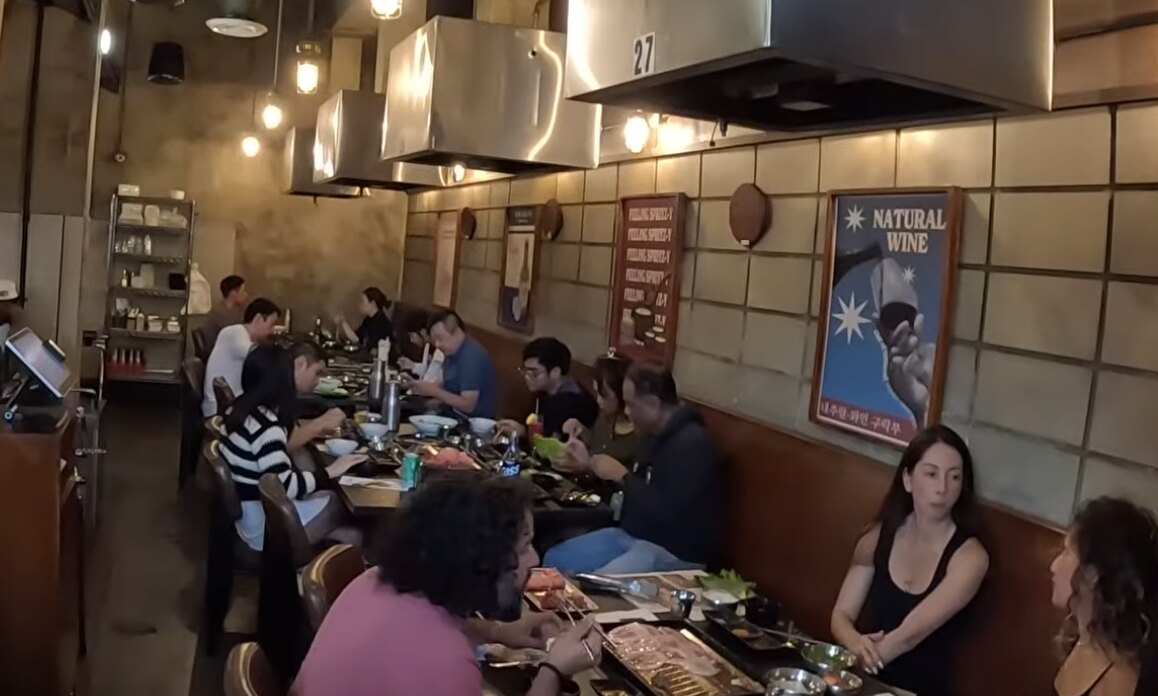
A samgyeopsal house packed with American diners

What it means to join early

  1. 01

    First entry, first footing

    A category's first brand takes root in the U.S. The agent who helps get it off the ground stands at the front of the line.

  2. 02

    Trust, proven

    A track record of landing a brand on the ground is trust proven by results, not words.

  3. 03

    The next, together

    Building on that trust, it's only natural to be the first we talk to about the next brand — or expansion into another country.

So it's an easy case to bring to your company

For an agent-company lead, this is a proposal that's easy to get through internally — proven demand for authentic Korean food, a zero-cost structure for the head restaurant, and an opportunity that grows the earlier you join. Weighing the business factors, the odds of getting your company's go-ahead look strong. Rather than hesitate, make the case boldly — it can be the first step to being recognized inside your company as the one who spotted a winning project.

* Internal reference figure among interested leads; not a guarantee of outcome.

0 Leads getting their company's go-ahead

This isn't a special promise of ours but a common practice in franchising — offering an operator who succeeded with one area or brand the first opportunity for adjacent areas or further expansion (‘right of first refusal’ / area development).

03 No Burden, No Obligation

Because this begins remotely, you may hesitate — “could this create an obligation?” So we'll simply state the facts. A partnership is only a way to express interest, and the head restaurant bears no cost.

A partnership is ‘expressing interest’ — no legal obligation

  1. 1

    Expressing interest

    A partnership is simply stating “I'm interested.” The application's required checkboxes themselves state that it carries no legal obligation.

    stop here — zero burden
  2. 2

    Matching · talking

    Finding a well-matched head restaurant and agent, and discussing terms and direction at length — a no-pressure way to explore.

    stop here — zero burden
  3. 3

    Formal contract

    Only here do legal obligations arise. Until then, if you change your mind, you simply don't proceed.

    obligations start here

No legal duty arises at the partnership stage. This isn't a device we invented — it's simply the nature of an MOU.

What the head restaurant pays — who covers it

  • Legal review of the contract Operator covers
  • AI learning system · infra Operator covers
  • Partnership · expansion costs Operator covers
So across partnership and expansion, the head restaurant's cost is $0

The head restaurant only needs to bring one thing — the deep taste built over years.

04 Gauging U.S. Demand — What the 'Likes' Mean

Each head-restaurant card on the partnership-roster page has a small heart. We plan to draw U.S. consumers to this site through various channels over time, and the heart is how a U.S. consumer says “I'd love to see this place in America.” It's a way to gauge, in advance, which restaurants are most anticipated on the ground.

○○ Restaurant Stews & soups
(example — the real button is on the roster)

How it works

  1. 1

    Visiting from the U.S.

    Your region is determined on the server, so the heart is active only for U.S. connections — read from the connection itself, with no login or input required.

  2. 2

    A heart for a head restaurant

    On the partnership-roster cards, tap a heart for the restaurants you'd want to see in America.

  3. 3

    Up to 3, no take-backs

    Up to three per person. Not a casual ‘like’ — to capture what people truly want, a choice can't be undone.

  4. 4

    Demand that builds quietly

    Per-restaurant counts are never shown publicly; to avoid restaurant-vs-restaurant comparison, only the operator references the figures.

Why can't it be tapped from Korea?

Because the goal is reading U.S. market demand. We want interest from the ground where brands will actually launch, not Korean preferences — so the visitor's region is determined on the server, and the heart opens only for U.S. connections. Since what matters is which region the interest comes from, that determination happens on the server, not in the browser.